


Introduction
In the United States, workplace safety isn’t just a best practice – it’s a legal mandate. The backbone of these protections is the Occupational Safety and Health Act of 1970, which established the federal Occupational Safety and Health Administration (OSHA). The primary focus of OSHA is to assure workers have a safe and healthful working conditions free from unlawful retaliation. Public sector employers and most of the private sector employers along with their workers falls within the ambit of the act.
Federal OSHA : The National Baseline
Federal OSHA is a division of the U.S. Department of Labor. Its primary mission is to ensure that employers provide a work environment “free from recognized hazards” that could cause death or serious harm. It covers most private-sector employers and their workers in all 50 states, the District of Columbia, and other U.S. territories.
What are State Plans?
- Nothing in this Act shall prevent any State agency or court from asserting jurisdiction under State law over any occupational safety or health issue with respect to which no standard is in effect under section 6.
- Any State which, at any time, desires to assume responsibility for development and enforcement therein of occupational safety and health standards relating to any occupational safety or health issue with respect to which a Federal standard has been promulgated under section 6 shall submit a State plan for the development of such standards and their enforcement.
To get the green light from the federal government, a State Plan must be “at least as effective” as federal OSHA standards. In many cases, states choose to be more stringent. For example, California (Cal/OSHA) has specific standards for heat illness prevention and wildfire smoke that exceed federal requirements.
Do I follow State or Federal rules?
If your state has its own OSHA-approved plan, the state agency (not the federal government) is the primary regulator.
Comprehensive State Plans | Both private sector and state/local government workers.
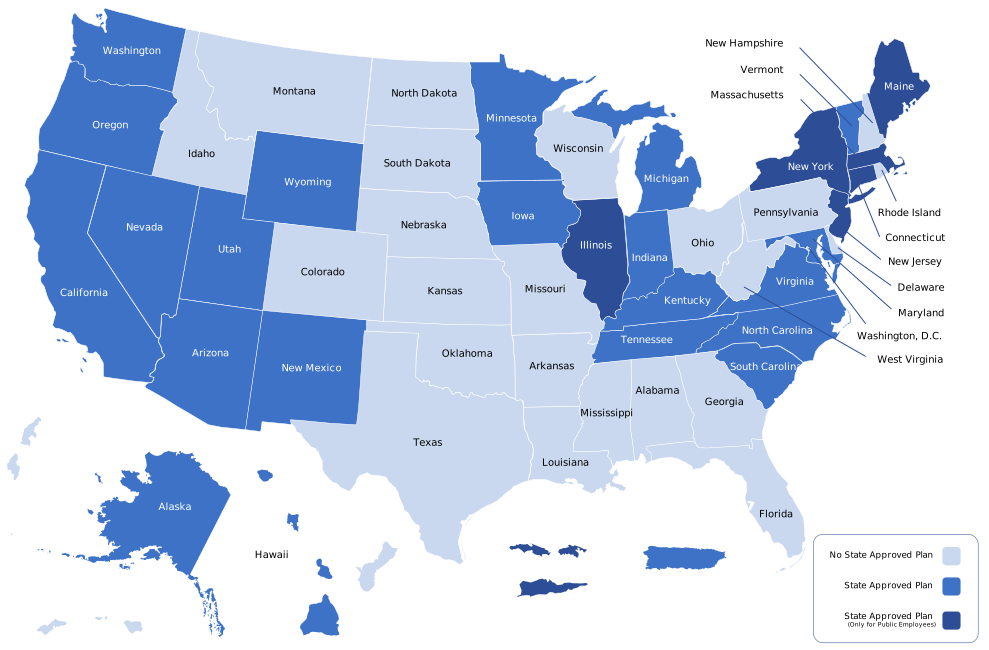
Public Employee Only Plans | Only state and local government workers; federal OSHA handles the private sector.
Federal Jurisdiction | Federal OSHA handles both private and federal workers (State/local government workers usually have no OSHA coverage in these states).
Key Rule: If you are in a “State Plan” state, you are generally not required to follow federal OSHA directly, because the state has already incorporated (or improved upon) those federal rules into its own law.
Regulatory Compliance : The “Must-Dos”
Staying compliant involves more than just “being safe.” It requires a documented, proactive approach. Most OSHA standards (both state and federal) require:
- Hazard Communication: Maintaining Safety Data Sheets (SDS) and labelling all chemicals.
- Personal Protective Equipment (PPE): Providing protective gears like helmets, gloves, or respirators at no cost to the worker.
- Recordkeeping: Employers with more than 10 employees must maintain a log of serious work-related injuries and illnesses.
- Training: Workers must be trained on hazards in a language and vocabulary they understand.
The Cost of Cutting Corners : 2026 Penalties
OSHA adjusts its penalties annually for inflation. For 2026, the financial consequences of non-compliance are higher than ever.
| Violation Type | Max Penalty (per violation) | Description |
|---|---|---|
| Serious | $16,550 | Hazards with a high probability of death or serious harm. |
| Other-Than-Serious | $16,550 | Direct relationship to safety but unlikely to cause death. |
| Wilful or Repeated | $165,514 | Intentional disregard for rules or repeating a past violation. |
| Failure to Abate | $16,550 per day | Failing to fix a hazard by the deadline set in a citation. |
Beyond the Fines
While the fines are steep, the “hidden” costs are often worse:
- Reputational Damage: Citations are public record and can affect your ability to win contracts.
- Worker’s Comp: Rates often skyrocket following a major OSHA incident.
- Legal Liability: In cases of “wilful” violations leading to death, criminal charges and imprisonment for executives are a real possibility.
Emerging Hazards in 2026 : Heat and Technology
As of 2026, OSHA has significantly expanded its focus to modern challenges:
Heat Illness Prevention: New federal and state standards now mandate specific rest-water-shade protocols for both outdoor (construction, agriculture) and indoor (warehousing, kitchens) environments.
Workplace Violence: Particularly in healthcare and social services, OSHA now expects employers to have a formal “Workplace Violence Prevention Program” to mitigate risks of physical harm from clients or patients.
Lone Worker Safety: With more remote and isolated work, OSHA emphasizes monitoring and check-in procedures for employees working without immediate backup.
The Whistle-blower Protection Program
A critical pillar of the OSH Act is Section 11(c), which protects employees from retaliation.
Protected Activities: Workers cannot be fired, demoted, or harassed for reporting a hazard, requesting an inspection, or refusing to perform a task that involves a “risk of death or serious physical harm.”
Rights to Information: Workers have the legal right to see their own medical records and the company’s injury logs (OSHA 300 logs).
Anonymity: When a worker files a complaint, OSHA is legally bound to keep their identity confidential from the employer during the investigation.
The Enforcers : Who Holds the Power?
Understanding OSHA requires looking at the “Split-Enforcement Model” used in the United States. Unlike some agencies that act as judge, jury, and executioner, the authority to enforce OSHA laws is shared between different bodies:
The Secretary of Labor & OSHA: These are the “prosecutors.” Federal OSHA (under the Dept. of Labor) sets the standards and sends Compliance Safety and Health Officers (CSHOs) to inspect workplaces. They have the authority to issue citations and propose fines.
The Occupational Safety and Health Review Commission (OSHRC): This is an independent federal agency – totally separate from the Department of Labor. If an employer disagrees with a fine, they appeal to the OSHRC, not to OSHA itself.
State Attorneys General: In some “State Plan” states, criminal negligence that leads to a worker’s death can be prosecuted by state authorities under manslaughter or reckless endangerment laws, moving the case from a civil fine to a criminal trial.
The Inspection Process : Priorities and Protocol
An OSHA inspection is rarely a random “surprise” for low-risk businesses. Because there are millions of workplaces and only a few thousand inspectors, they follow a strict hierarchy of priority:
Imminent Danger: This is the highest priority. If OSHA receives a tip that a worker is currently standing in an un-shored 10-foot trench or working on a roof without any fall protection, they will arrive within hours.
Severe Injuries and Fatalities: Employers are legally required to report a death within 8 hours and any “catastrophic” injury (amputation, loss of an eye, or hospitalization) within 24 hours. These reports almost always trigger an immediate on-site inspection.
Worker Complaints & Referrals: If an employee files a formal complaint, they have a right to an inspection. “Referrals” can also come from other agencies, like the fire department or health department, who notice a hazard while doing their own rounds.
Targeted (Programmed) Inspections: These are “random” but data-driven. OSHA targets specific industries with high injury rates, such as warehousing, chemical manufacturing, or roofing. If you are in a “High Hazard” industry, you are on the list for a routine check.
Conclusion
OSHA compliance is not a “one and done” task, it is a continuous cycle of assessment, training and documentation. Whether it is Federal OSHA or State Plan, the objective is to ensure that a worker with end of every shift, goes home in the same state they arrived at work. To meet the objectives and purpose of OSHA, a collective effort of employer, employees and the authorities is required. With the collective, balancing and collaborative efforts, businesses can achieve higher productivity with efficiency and effectiveness, along with actively participating in protection of human rights and dignity.
Disclaimer
The information provided in this article is intended for general informational purposes only and should not be construed as legal advice. The content of this article is not intended to create and receipt of it does not constitute any relationship. Readers should not act upon this information without seeking professional legal counsel.