


Renewable Energy sector in India has seen a notable growth in the past few years. Rajasthan has become one of the state with most advancements in the solar energy sector because of its favorable climate, land resources and supportive governmental policies. With the growth, the renewable energy compliance in Rajasthan is becoming important for developers, DISCOMs, open access consumers, captive users and investors. The increasing focus on the regulatory framework leaves no room for non-compliance. Hence, the stakeholders are proactively aligning themselves to the mandatory RPO guidelines to avoid the severe penalties.
Adherence to environmental regulations, grid connection standards, open access guidelines and power sector policies is now important regulatory part for fostering sustainable growth, to attract investors confidence, and enhancing operational efficiency in the state’s blooming solar market. As renewable energy expands, proper regulation of renewable energy compliances in Rajasthan is necessary to ensure a smooth process for developers, open access consumers, investors and DISCOMs. India’s transition towards green energy expansion is expected to grow faster than many other existing major economies by 2035 and the country is expected to account for over 23 per cent of global energy demand by 2050, the highest for any country.
RAJASTHAN’S EXPANDING SOLAR AND RENEWABLE ENERGY ECOSYSTEM
- Rajasthan’s expansion in solar ecosystem is rapidly driven by geographical sources that can be fetched from the nature itself. This includes approximately 325 sunny days a year which has a direct implication of the higher solar radiation, abundant barren land, the broad terrain lands, high energy yields and strong wind speeds with many other key factors.
- The state is home to some of the largest solar infrastructure projects and major operational facilities including the Bhadla Solar Park, Pugal Solar Park, Nookh Solar Park & Fatehgarh Phase – 1B which majorly spreads over Jodhpur, Jaisalmer and Bikaner regions in Rajasthan. In order to support these power plants, the state and central government are expanding are implementing major infrastructural through the Green Energy Corridor, Upcoming Capacity, Plug and Play Facilities. Another significant advancement in India’s renewable energy sector is on the horizon as Rajasthan prepares to host the world’s largest solar park, being developed in Bikaner, with a planned generation capacity of 2,450 MW
- The Rajasthan Government offers various incentives to expand solar ecosystems which includes Sunrise Thrust Sector Incentives, Asset Creation Incentives amongst the various other incentives. These incentives majorly offer capital subsidiaries, financial boosters, tax benefits etc to promote the solar infrastructure.
KEY REGULATORY FRAMEWORK FOR RENEWABLE ENERGY GOVERNANCE
-
ELECTRICTY ACT, 2003
The act stands as core legal framework for India’s power sector as it supports renewable energy by mandating the purchase of green power, establishing mechanisms like Renewable Energy Certificates (RECs), promoting non-fossil energy consumption obligations. The act empowers State Electricity Regulatory Commissions (SERCs) to set minimum percentage of electricity that distribution companies must procure from renewable sources, allowing open access by enabling a large number of consumers to generate power directly from solar bypassing local distribution companies, encouraging localized solar and biomass systems to provide power in remote areas without relying on central grids to accelerate the country’s energy transition.
-
RAJSTHAN SOLAR ENERGY POLICY, 2019
The policy has been framed to propel Rajasthan as a forefront of India’s clean energy sector with the aim of converting the vast vacant dessert land area to a 30GW capacity solar plant to promote solar energy & make it cost effective In furtherance, a formalized process was developed with respect to registration, approval and development of solar parks. The policy also states that the State will promote development of Solar Parks in Joint Venture with private developers by investing up to 50% equity or any other percentage of equity participation as decided by state government.
-
RENEWABLE PURCHASE OBLIGATIONS (RPO)
- As per the said obligation, it is mandatory for Rajasthan’s power distributors (DISCOMs) to buy a minimum percentage of their electricity from the renewable sources as directed by the Rajasthan Electricity Regulatory Commission (RERC These rules promote renewable energy use and ensure compliance, shaping a sustainable energy future for the region.
- As per the recent developments under The Energy Conservation (Amendment) Act, 2022, Passed by Parliament- RPO are now strictly governed by central government regulations and the entities which are obligated are required to consume a specific percentage of their total electricity from renewable sources. The governing authority Rajasthan Electricity Regulatory Commission (RERC) later moved toward adoption of Renewable Consumption Obligation (RCO) framework, effective from March 19, 2026.
-
GREEN ENERGY OPEN ACCESS RULES
Green Energy Open Access rules were introduced to surpass the traditional grids with the aim of reducing the carbon footprint. It has allowed the consumers to directly purchase the electricity from renewable energy generators or procure green power through distribution companies.
-
RAJASTHAN RENEWABLE ENERGY POLICY, 2023
To further promote renewable energy and its integration with grid, this policy framework aimed to transform Rajasthan into a clean energy powerhouse with a focus on capacity generation and investment incentives. Rajasthan Renewable Energy Policy, 2023 targeted 90 GW renewable capacity up to 2029-30, while Rajasthan Integrated Clean Energy Policy, 2024 increased the target to 125 GW by 2029-30.
RENEWABLE ENERGY COMPLIANCE CHECKLIST
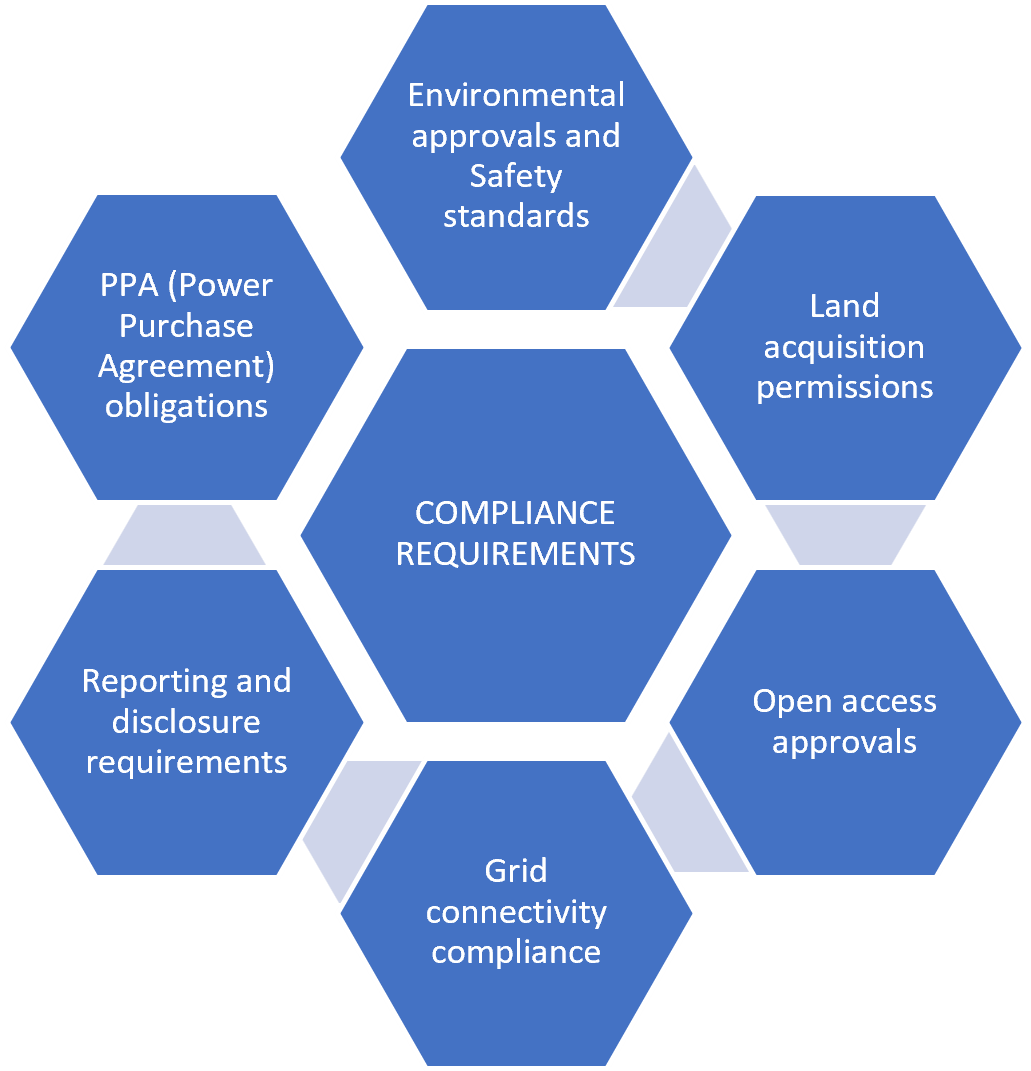
- All state-level approvals must be tracked and policies applied for via the Rising Rajasthan portal.
- All rooftop solar projects must be registered and processed using the RRECL Single Window System via the state SSO portal.
- Electrical Inspectorate Certification: Required for plant capacities over 1 MVA or voltages above 33 kV. units up to 33 kV can utilize self-certification.
- Land use conversion: Converting agricultural land for a solar farm requires a Change of Land Use (CLU) order from the local district collector/ Revenue Department.
- Grid connectivity and net metering approval: Mandated by RERC Regulations a formal application must be submitted by your local DISCOM
FINANCIAL PENALTIES FOR RENEWABLE ENERGY NON-COMPLIANCE
| Violation Category | Targeted Entity | Regulatory Basis | Financial Penalty Matrix | Impact & Recovery |
|---|---|---|---|---|
| RPO / RCO Shortfall | Obligated Entities (Large Industries, Open Access, Captive Users) | RERC Renewable Energy Obligation Regulations | Shortfall (in Units) multipled by REC Forbearance Price (deposited into a dedicated state green fund). | Compulsory funding used strictly to develop local green transmission infrastructure. |
| Willful Non-Compliance & Grid Delays | Utility Developers & Corporate Power Plants | Section 142 of the Electricity Act, 2003 | Up to ₹1 Lakh per infraction+ a compounding daily penalty of ₹6,000/ day for continuing violations. | Charges must be paid directly by the corporate entity; strictly disallowed as a pass-through cost. |
| Violation of Domestic Content Requirement (DCR) | EPC Vendors & Commercial Project Contractors | Ministry of New and Renewable Energy (MNRE Directions) | Blacklisting up to 3 years+ complete forfeiture of central/state performance bank guarantees. | Immediate cancellation of solar subsidies and systemic blocking from future state tenders. |
| Unauthorized Net Metering Exceedance | Residential Rooftop & Small Commercial Owners | Discom Distribution Supply Code | Excess peak unit billing rates applied on billing cycle overages. | Generated energy exceeding contract demand ceilings is treated as un-notified and forfeit. |
The extraordinary surge in capacity can lead to exponential growth over the next decade for Rajasthan’s solar sector. Transforming this geographic advantage into long-term investment depends profoundly on severe legal framework configuration and proactive compliance management. For global investors looking toward India, vigorous compliance serves as the ultimate risk-mitigation tool to de-risk high-value cross-border investments.
Frequently Asked Questions (FAQS)
The Rajasthan Electricity Regulatory Commission (RERC) sets rules, and the Rajasthan Renewable Energy Corporation (RREC) implements state policies.
Rajasthan has shifted from Renewable Purchase Obligation (RPO) and fully adopted the central Ministry of Power’s Renewable Consumption Obligation (RCO) framework. This aligns the state with India’s unified national standards and eliminates overlapping compliance rules for power distribution companies (DISCOMs), open-access consumers, and captive users.
Compliance management software takes the headache out of tracking fast-changing local green laws, saving companies from massive penalty fees. It handles everything automatically.
Disclaimer
The information provided in this article is intended for general informational purposes only and should not be construed as legal advice. The content of this article is not intended to create and receipt of it does not constitute any relationship. Readers should not act upon this information without seeking professional legal counsel.
Informative