


Through the Energy Conservation (Amendment) Act, 2022, the Government of India established a comprehensive legal framework for the Carbon Credit Trading Scheme (CCTS), first notified in 2023 (supersedes and integrates the PAT Scheme (Perform, Achieve & Trade) to establish the Indian Carbon Market (ICM), aligning with India’s climate commitments under the Paris Agreement. The Scheme follows a phased implementation to regulate India’s domestic carbon market. The framework mandates the issuance of Carbon Credit Certificates (CCCs).
The Scheme is India’s national “Cap-and-Trade” framework. It creates a market where carbon dioxide ($CO_2$) is no longer a free byproduct of industry but a financial asset or liability.
Think of a carbon credit as a ‘pollution permit’ with a price tag. In the Indian Carbon Market (ICM), companies are given a strict budget for their greenhouse gas emissions. Those who emit less than the permissible limit earn Carbon Credit Certificates (CCCs), valuable assets they can sell for profit. Conversely, companies that fail to meet the targets shall buy Carbon Credit Certificates (CCCs), from the market to cover their shortfall. This system changes environmental responsibility into a competitive business advantage, further ensuring that the cleanest companies are also the most profitable.
The following are the responsible Institutes “Trifecta” under the scheme:
- Ministry of Power (MoP): The Nodal Ministry for policy.
- Bureau of Energy Efficiency (BEE): The Administrator They develop methodologies, benchmarks, Measurement, Reporting, and Verification (MRV ) protocols, and administer registries.
- Ministry of Environment (MoEFCC): They notify the actual emission targets and ensure the scheme aligns with India’s goal of Net Zero by 2070.
The Timeline: The scheme is rolling out in specific phases:
Phase 1 (2024–2025): Establishing the “Registry” (managed by Grid-India) and setting “Emission Intensity Targets” for the first 9 sectors.
Compliance Market Launch (Mid-2026): The Power Minister has indicated that the first official trades of compliance-based Carbon Credit Certificates (CCCs) are expected to take place by October 2026.
Voluntary Market (Active Now): The “Offset Mechanism” for non-obligated sectors (like farming and forestry) is already being operationalized as of early 2026.
The Need: Why do we need it?
Beyond Energy Efficiency: CCTS is needed because it tracks actual greenhouse gas (GHG) emissions, which is a more accurate way to fight climate change
Economic Survival (The CBAM Factor): Starting in 2026, the EU is taxing imports based on their carbon footprint. Without a domestic carbon market, Indian exporters would pay that tax to Europe; with CCTS, they can pay a lower “price” within India and avoid double taxation.
Innovation Push: Without a financial penalty for polluting, companies have little incentive to switch from cheap coal to expensive green energy. CCTS makes “being green” a profitable business decision.
The Aim: Why was this created?
The primary goal is to decarbonize the Indian economy by putting a financial price on carbon emissions.
Targeted Reduction: To help India achieve its NDC (Nationally Determined Contributions) goal of reducing emission intensity by 45% by 2030 (compared to 2005 levels).
Resource Mobilization: To direct private capital toward green technologies like Green Hydrogen, Carbon Capture, and Renewable Energy.
As of January 2026, the Indian Carbon Market (ICM) has moved into its critical implementation stage. This transition from the old energy-saving scheme (PAT) to the new emission-based scheme (Carbon Credit Trading Scheme (CCTS)) is happening in two (2) distinct streams:
- Compliance Mechanism (Mandatory)
- Offset Mechanism (Voluntary).
| Mechanism | Who uses it? | How is it used? | Phases, Timelines, Key Milestones |
|---|---|---|---|
| Compliance | Big Industry (cement, iron and steel, aluminum, fertilizer, etc.) | If a factory exceeds its limit (e.g., emits 10k tonnes vs 8k limit), they must buy 2,000 credits to avoid fines. | Preparation (2024 – Oct 2025): Finalization of MRV (Monitoring, Reporting, and Verification). |
| Phase-1 Active (April 2025 – March 2026): First Compliance Year. ~800 plants implementing 1–3% reduction plans. | |||
| Phase-2 (April 2026 – June 2026): Submission of first verified GHG reports to the BEE. | |||
| Trading Launch (October 2026): CCCs issued and traded on exchanges (IEX/PXIL). | |||
| Offset | Farmers / Startups / Green Firms | Projects (forests, soil) “mint” credits to sell for cash to the big industries above. | Phase 1 (2025): Focus on 6 sectors: Energy, Ag, Forestry, Waste, Transport & Industry. |
| Phase 2 (Late 2026+): Expansion into Construction, CCUS & Advanced Removals. |
*The government plans an expansion to the coal-fired power generation sector in the next stage.
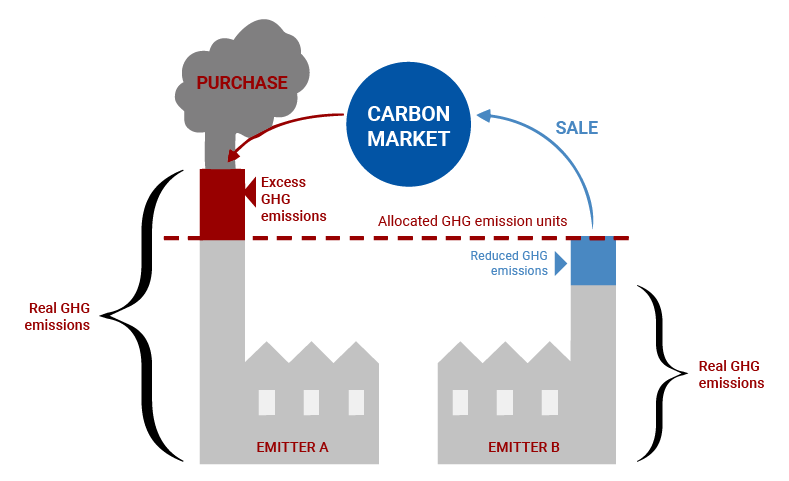
“The Carbon Credit Trading Scheme (CCTS) is effectively India’s new ‘green stock exchange.’ It replaces traditional pollution penalties with a market-based logic: meet your carbon target and you earn tradable ‘golden tickets’ called Carbon Credit Certificates (CCCs); miss it, and you pay. This shift turns the Indian Carbon Market (ICM) into a powerful engine for accountability, where ‘laggards’ fund the ‘leaders’ of the energy transition. It’s a visionary system that doesn’t just cut smoke— it fuels innovation in clean tech and ensures Indian industries are future-proofed for a global economy that increasingly prizes carbon efficiency over raw output.”
The Compliance Cycle: How it Works
The process for industries (like Steel, Cement, and Aluminium) follows a strict annual loop:
- Setting of Target: Ministry of Environment, Forest and Climate Change (MoEFCC) notifies emission intensity targets (tonnes of $CO_2$ per unit of product).
- Monitoring & Reporting: Industries track their emissions according to a pre-approved Monitoring Plan.
- Verification: Accredited Carbon Verification Agency (ACVA) audits the data.
- Issuance/Purchase: * Overachievers: Earn Carbon Credit Certificates (CCCs) (1 credit = 1 tonne of $CO_2e$ saved).
- Underachievers: Must buy Carbon Credit Certificates (CCCs) from the market to meet their shortfall.
- Trading: Trading occurs on designated power exchanges within a “price collar” (floor and ceiling prices).
CONCLUSION:
Carbon Credit Trading Scheme (CCTS) marks a significant step towards reduction in overall GHG emissions and adherence to the climate policy architecture. This scheme aims to put a price on the carbon thereby reducing the overall emission intensity by 2030. The structure it aims to adopt is very broad and flexible whereby the it is mandatory for the obligated entities to comply with the provisions and on the other hand it is a voluntary offset mechanism is set for the non-obligated entities to encourage them to help in overall decarbonization. To summarize, the Carbon Credit Trading Scheme (CCTS) goes beyond being just a regulatory obligation; it serves as a strategic economic instrument that utilizes market dynamics to facilitate the climate transition. The effectiveness of this scheme depends on strong implementation, regular target establishment, and efficient enforcement; however, it establishes a crucial groundwork for propelling India towards its Net-Zero goal by 2070 while also promoting sustainable growth and innovation.
References:
- https://icapcarbonaction.com/en/ets/indian-carbon-credit-trading-scheme
- https://www.drishtiias.com/daily-updates/daily-news-editorials/future-of-carbon-trading-in-india
- https://vajiramandravi.com/current-affairs/carbon-credit-trading-scheme/
- https://beeindia.gov.in/carbon-market.php
- https://www.ieta.org/uploads/wp-content/Resources/Busines-briefs/2025/IETA_Business_Brief-India_July_final-one.pdf
- https://www.climatepolicylab.org/communityvoices/2025/5/22/from-pat-to-ccts-can-indias-new-carbon-market-fix-the-past
- https://www.drishtiias.com/daily-updates/daily-news-analysis/carbon-credit-trading-scheme
- https://www.drishtiias.com/daily-updates/daily-news-editorials/carbon-credits-in-india-hopes-and-challenges
- https://ecodrisil.com/indias-carbon-credit-trading-scheme-ccts-opportunities-challenges/
- https://moderndiplomacy.eu/2025/10/04/eu-carbon-credit-integration-what-it-means-for-indias-climate-and-trade-future/#:~:text=World%20News-,EU%20Carbon%20Credit%20Integration:%20What%20It%20Means%20for%20India’s%20Climate,%2C%20export%20competitiveness%2C%20and%20sovereignty.
Disclaimer
The information provided in this article is intended for general informational purposes only and should not be construed as legal advice. The content of this article is not intended to create and receipt of it does not constitute any relationship. Readers should not act upon this information without seeking professional legal counsel.