


Introduction
Reporting of Beneficial Ownership is a global initiative taken by the Financial Action Task Force (FATF). It aims to identify the person who ultimately owns or control the business especially when their names are omitted from the company records or the ownership of company is layered through holding companies, trusts, nominee shareholders or foreign entities.
Who is a Beneficial Owner (BO)?
Beneficial owner is defined as a natural person who owns or controls an entity or on whose behalf a transaction is conducted in an entity, irrespective of the fact that the name of person does not appear as the legal owner in official records of the entity.
For an example:
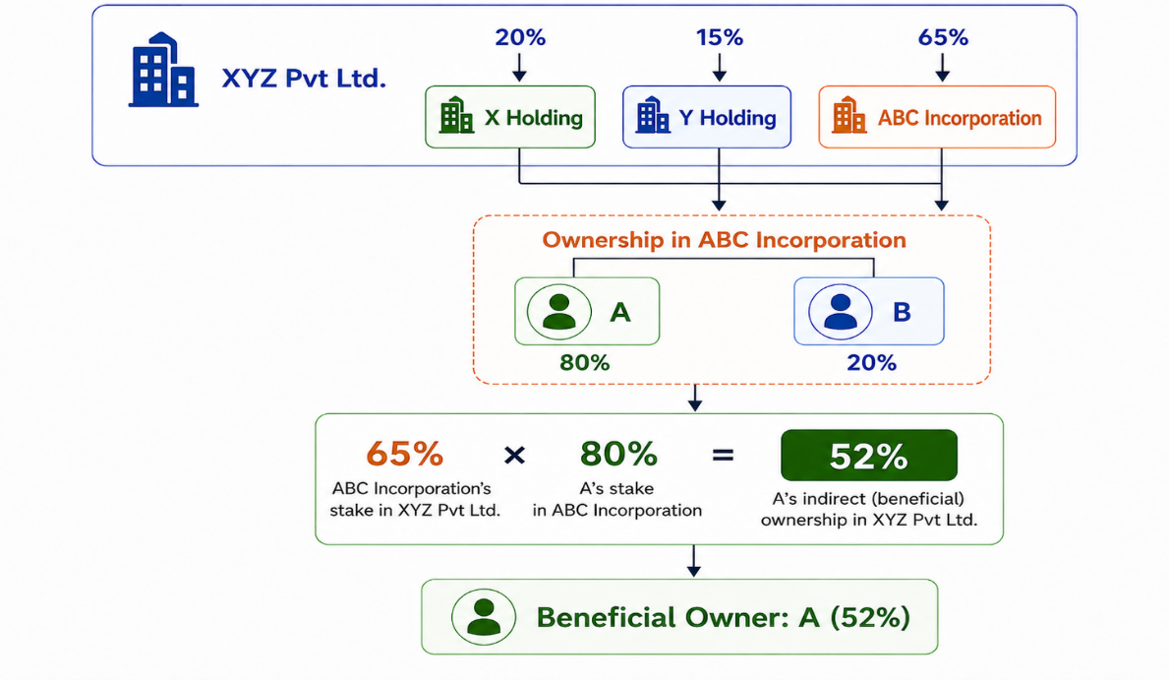
Company XYZ Pvt Ltd. is directly owned by ‘X’ having a share of 20%, ‘Y’ having a share of 15%. Another company namely ‘ABC Incorporation’ has 65% stake in ‘XYZ’. Since ABC Incorporation is owned by ‘A’ having 80% stake in ABC and ‘B’ having a stake of 20%, which ultimately makes ‘A’ the beneficial owner of 52% in XYZ Pvt Ltd.
Beneficial owner may:
- Hold ownership directly or indirectly
- Exercise significant voting rights
- Influence management decisions
- Control the entity through contractual arrangements
- Receive the economic benefits generated by the business
Different jurisdictions use different terminologies to identify beneficial owners such as:
European Union
Ultimate Beneficial Owner (UBO)
UK
People with Significant Control (PSC)
US
Beneficial Ownership Information (BOI)
India
Significant Beneficial Owners (SBOs)
Distinction between Legal Ownership and Beneficial Ownership
Understanding the difference between legal and beneficial ownership is crucial. Although they are distinct, yet closely connected and often confused with each other. Here is a quick breakdown:
Legal Owner
Natural Person or Legal Entity
Holds the formal or legal title
Highly visible and easy to trace on paper
Beneficial Owner
Natural Person
Exercises ultimate control or enjoys the financial benefits
Often invisible and difficult to trace on paper
Objectives of Reporting
The Primary objective of Beneficial ownership reporting is to strengthen the corporate transparency and protects the integrity of the global financial system and to:
- Identify real individual behind a company
- Prevent misuse of corporate structure
- Promote corporate transparency and accountability
- Assist regulatory law enforcement authorities
- Enhance investor and market confidence
- Meet international standards
- Prevent money laundering, terrorist financing, and proliferation financing
- Facilitate international cooperation
Procedure of Beneficial Ownership Reporting
International agency namely Financial Action Task Force (FATF) has issued certain recommendations which are evolving continuously to achieve higher level of transparency, even after there exists no single global framework which governs beneficial owner reporting. Although the terminologies, ownership threshold, reporting authority and the compliance obligations varies from jurisdiction to jurisdiction, the basic objective of identifying the individuals who control the legal entity remains the same, notwithstanding the fact that the compliance procedures vary from different jurisdictions, which broadly involves the following steps:
- Preparation of ownership structure: The first step is to map the entity’s ownership structure in its entirety. This involves identifying all direct and direct shareholders, parent companies, subsidiaries, trust and any other legal arrangements through which ownership or control is exercised.
- Identification of beneficial owners: Once the ownership structure has been established, organisations must determine who qualifies as a beneficial owner under the applicable laws of the relevant jurisdiction.
- Collection of required information: Typically, this includes basic identifying credentials of an individual, depending upon jurisdiction additional information or supplementing documents may also be required
- Obtain declaration from relevant person: Through this declaration, individual confirms the accuracy of the information provided and discloses the way ownership or control is exercised.
- Verification of information: Organisations take reasonable steps to verify the accuracy and authenticity of collected information
- Creation and maintenance of internal ownership records: Once collected and verified, should be recorded in the prescribed registers or records
- Submission of ownership information to designated authorities: Organisations are required to submit the verified and collected information to the competent authority of their respective jurisdiction
- Filing whenever ownership or control changes: Beneficial ownership is not one-time exercise. Organisations must continuously monitor changes in ownership and control and update their internal records as well as any required regulatory filings whenever required.
Beneficial Ownership Reporting Threshold
Companies are required to report beneficial ownership to their respective authority once the ownership and controlling interest of a member reaches to regulatory threshold.
Countries may use different ownership threshold to determine beneficial owners based on ownership interests. Hence, any person whose direct or indirect ownership reaches to a certain percentage is required to make disclosures to the company.
As recommended by Financial Action Task Force (FATF), threshold should not exceed a maximum of 25% and countries may consider combined ownership interests (E.g., shareholders working together).
While major jurisdictions have adhered to a standard 25% beneficial ownership threshold, as recommended by FATF, like the United States, United Kingdom, China, Australia, Brazil, European Union, Canada, United Arab Emirates and others, there are countries having more stringent thresholds like 20%, 15%, 10% or 5% to maximize corporate transparency.
- Angola
- Argentina
- Dominican Republic
- Malaysia
- Philippines
- Qatar
- Bolivia
- Uruguay
- Bahrain
- Costa Rica
- Egypt
- India
- Kazakhstan
- Kenya
- Peru
- Colombia
- Nigeria
- South Africa
- Tanzania
While every other jurisdiction around the world requires the entities to report beneficial ownership on the basis of ownership or control thresholds, there are some exceptions like Ecuador, which has eliminated the minimum threshold completely and requires disclosure of beneficial ownership regardless of ownership percentage.
Timeline for reporting
Companies are required to provide basic and beneficial ownership information to the designated authorities:
- At the time of Registration,
- Periodically, and
- Within a reasonable period following to any change in the beneficial ownership information.
Key Challenges Businesses Face
Beneficial ownership reporting is rarely straightforward and often encounter challenges such as:
- Multi-layered ownership spanning several jurisdictions
- Frequent ownership changes requiring timely updates
- Complex trust and nominee arrangements
- Manual collection and verification of shareholder information
- Different reporting requirements across several jurisdictions
Consequences of non-compliance
Organisations which fail to comply with beneficial ownership reporting requirements may be subject to:
- Financial penalties
- Civil or criminal liability
- Regulatory investigations
- Reputational damage
- Increased compliance cost
Conclusion
Beneficial ownership reporting has evolved over the period of time and has become a cornerstone of global corporate transparency. Hence, organizations whether operating in a single jurisdiction or across multiple countries, must identify, verify, maintain, and report beneficial ownership accurately and on time. Over 140 countries have committed to or actively implemented beneficial ownership tracking frameworks.
Disclaimer
The information provided in this article is intended for general informational purposes only and should not be construed as legal advice. The content of this article is not intended to create and receipt of it does not constitute any relationship. Readers should not act upon this information without seeking professional legal counsel.

Join Our WhatsApp Channel For Global Regulatory Updates & Analysis Join Now