


Introduction
Money laundering is a major issue for any society’s social and economic wellbeing and is frequently referred to as the “Lifeblood of Crime”. Essentially, money laundering is the act of disguising “dirty” funds as “clean”. Many nations have recently made laws in order to deal with money laundering and Malaysia is one of them.
Malaysia’s updated anti-money laundering law from 2025 makes a major change, instead of just punishing the companies. The law now holds directors, managers, and employees di-rectly and personally responsible if they fail to follow the rules.
The Malaysian Anti Money Laundering Act (AMLA) was passed in 2001 and put into effect in January 2002. In order to address the financing of terrorism, this statute was revised in 2003. This act was renamed the Anti-Money Laundering and Anti-Terrorism Financing Act 2001 (AMLATFA) following the revision. Not only is AMLATFA a law against money laundering and terrorism financing, but it also puts various obligations on reporting institutions.
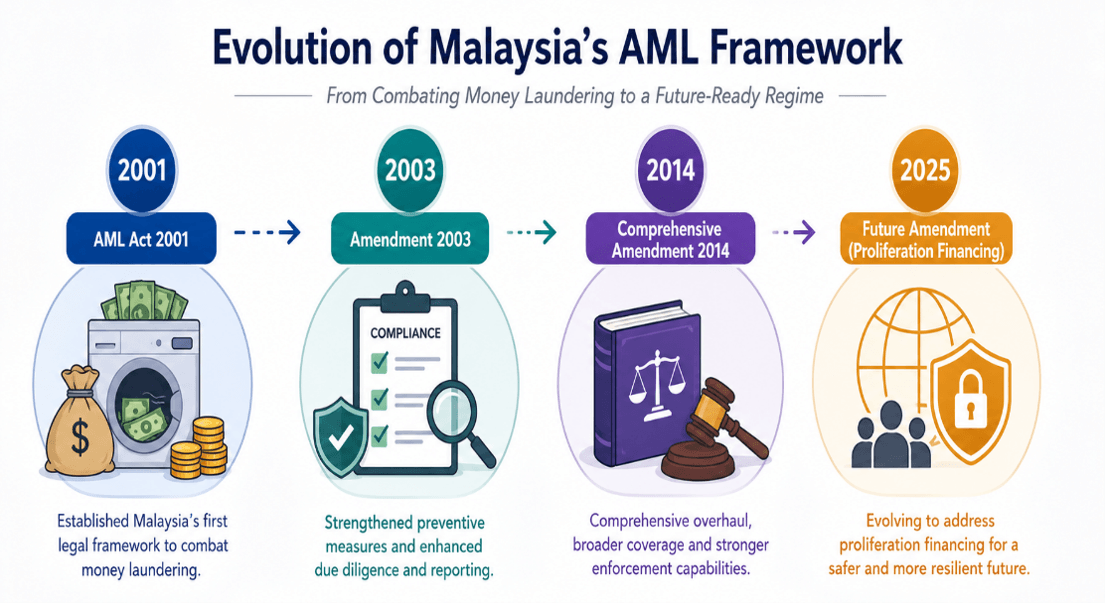
AML Act 2001
Amendment 2003
Comprehensive Amendment 2014
Future Amendment (Proliferation Financing)
The global battle against financial crime is always changing, necessitating the adaptation of legal frameworks to more complex illegal financing strategies.
Malaysia’s main Law-making against these dangers is the Anti-Money Laundering, Anti-Terrorism Financing and Proceeds of Unlawful Activities Act 2001 (hereinafter referred to as Old Act). This act has provided the foundation for financial intelligence, reporting obliga-tions, and the seizure of illegal goods for over two decades.
However, a big significant shift has taken place since the Anti-Money Laundering, Anti-Terrorism Financing and Proceeds of Unlawful Activities (Amendment) Act 2025 (hereinaf-ter referred to as AMLA Amendment Act 2025) was approved.

From Illegal Money To a Clean Economy
Placement
Illegal cash enters the financial system.
Layering
Complex transactions obscure the origin.
Integration
Money re-enters the economy as legitimate funds.
The 2025 Amended Act’s most significant shift is from corporate accountability to direct, explicit individual liability, which goes beyond the extension of targeted offenses.
The 2025 Amended Act guarantees that people can no longer hide behind the corporate veil of their reporting institutions by methodically incorporating “The director, officer, or em-ployee” into the daily compliance requirements.
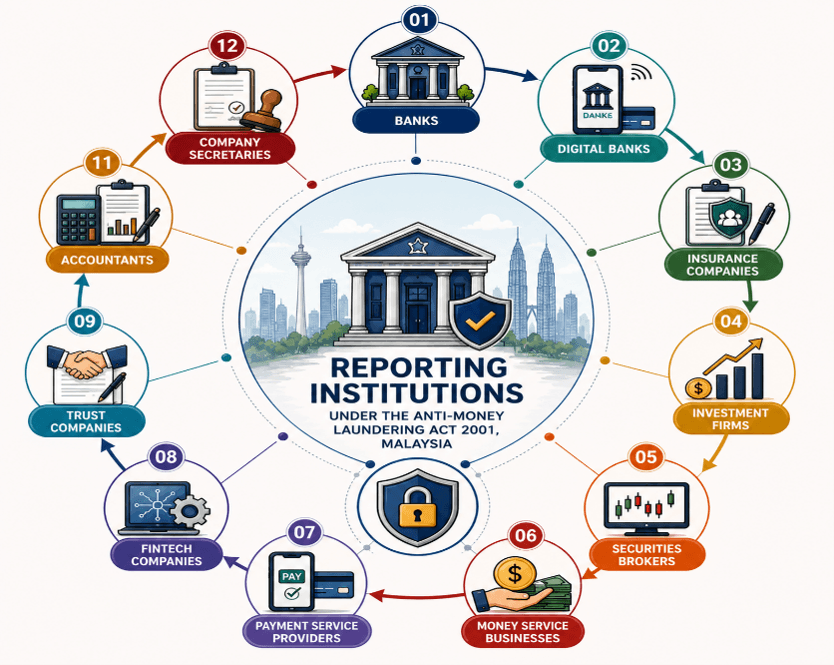
Reporting Institutions
Reporting institutions includes both financial and non-financial entities as mentioned in the chart below:
Key Changes Introduced Under the AMLA Amendment 2025
Although Old Act did not totally immunize people, its approach to personal liability was primarily indirect or secondary.
The main general offense provision that addressed individual accountability was Section 87, which stated that if a body corporate commits an offense, a director, controller, or officer is deemed to have committed the offense unless they can demonstrate that the offense was committed without their consent and that they took reasonable precautions to prevent it. Ad-ditionally, if the reporting institution failed to fulfil its responsibilities, Section 22 permitted the competent authority to seek court orders against officers or staff in order to compel com-pliance. However, because the institutional entity was solely responsible for the daily statu-tory burden of maintaining records, setting up centralized systems, and filing reports, it was difficult to hold a particular frontline employee or mid-level compliance officer directly ac-countable for frequent operational failures.

Individual Liability Under the AMLA Amendment 2025
The AML/CFT framework’s operational provisions are completely rewritten by the 2025 Amended Act. In order to specifically put “The Director, Officer or Employee of the Re-porting Institution” with the institution itself in all significant compliance responsibilities, the amendment methodically modifies the main act. Following points highlights the integra-tion of significant shift in the liability:
Record-Keeping and Data Centralization
The obligation is no longer exclusive to the entity under the revised Section 13(1). It cur-rently reads: “A reporting institution, or The Director, Officer or Employee of the re-porting institution shall keep a record of all domestic and international transactions or activities”.
In a similar way, Section 15, which regulates information centralization, has been changed to require that “A reporting institution, or the director, officer, or employee of the re-porting institution” shall establish, administer and maintain a system for centralization of information, rather than just the institution.
The institution’s human operators, including the board of directors, front-line tellers, and compliance analysts, are legally required to actively preserve records. Direct liability fol-lows failure to comply. Any director, officer, or employee who violates these standards is guilty of an infraction and faces a fine of up to 1000000 (One Million Ringgit), according to the penalty proposed under the new Section 13(5).
Customer Due Diligence (CDD) and Account Opening
Customer Due Diligence is the frontline defence against money laundering. The Old Act imposed on the reporting institution the responsibility of CDD (Section 16) and the ban on opening accounts under false names (Section 18).
By adding the “Director, officer or employee” to the chain of accountability, Amended Act modifies these crucial parts.
Additionally, under the amended Section 18, the “Reporting institution, or The Director, Officer or Employee shall comply” with specific directives or guidelines issued by the competent authority regarding the opening of accounts or conducting business under false names. A staff member may now face a direct fine of up to 1000000 (One Million Ringgit) for vio-lating certain CDD and account opening procedures.
Suspicious Transaction Reporting (STR) and Compliance Programs
The requirements pertaining to internal controls and reporting are also changed by the amendment. The new Section 14 gives the competent authority the authority to give specific instructions, guidelines, or conditions to the “Reporting institution, or the director, officer or employee” about how to identify suspicious patterns of behaviour, even though the insti-tution is still in charge of reporting. A direct violation is committed by any director, officer, or employee who violates these directed compliance measures.
In a similar way, the individual is now expressly bound by Section 19, which controls the execution of internal compliance procedures. The director, officer, or employee may receive direct requirements from the competent authority on compliance programs, and they are per-sonally responsible for ensuring compliance, failure to do so will result in a fine of 1000000 (One Million Ringgit).
Impact on Reporting Institutions of Personal Accountability in Anti-Money Laundering Compliance
The new enforcement measures in Anti-Money Laundering, amended act may be the strong-est indication of the significant shift towards individual. The 2025 amendment provides a multi-tiered enforcement mechanism that targets individuals through administrative and civ-il avenues, whereas old act mainly focused on criminal prosecutions and institutional license revocations.
According to the new Section 83A, the regulatory authority may order a reporting institution or its director, officer, or employee to execute an action plan or enter into a formal agreement to ensure compliance if they fail to comply with any requirement under the Act without a valid cause. A person who contravenes this particular order is guilty of a crime that carries a maximum fine of 1000000 (One Million Ringgit), a maximum of Three Years imprisonment, or both, in addition to daily fines for repeated crimes.
Amended Act gives the regulatory or competent body broad jurisdiction to take administrative action against anyone (including people) who violates the Act or disregards issued guidelines and circulars. The authorities can now directly impose a Monetary Penalty (up to 1000000 (One Million Ringgit) on an individual instead of conducting a drawn-out criminal prosecution. Without having to reach the criminal burden of proof in a court of law, this gives regulators a quick and very effective way to punish specific compliance officers or executives who fail in their duties.
Additionally, Section 83C, which permits the competent or supervisory authority to file a civil lawsuit against an individual for any violation of the Act’s regulatory sections (Part IV, VIA, VIB), is introduced by the 2025 Amended Act.
The new Section 83D represents the final amendment of personal accountability. If it seems that someone has violated the Act, the court has the authority to issue directives. If an offender is a director, manager, or chief executive officer of a reporting organization, the court may order their removal from office under Section 83D(1)(ff).
Conclusion
An important turning point in Malaysia’s financial regulatory history was the transition from the Old Act to the Amended Act where the legislature has created a shift that transfers the responsibility for anti-money laundering, counter-terrorism financing, and anti-proliferation financing from a system that previously penalized the anonymous “Reporting Institution” to “The Directors, Officers, and Staff” carrying out these duties. Financial professionals in Malaysia are now required to consider every transaction, record, and due diligence review as a direct personal legal obligation in addition to an institutional policy.
Disclaimer
The information provided in this article is intended for general informational purposes only and should not be construed as legal advice. The content of this article is not intended to create and receipt of it does not constitute any relationship. Readers should not act upon this information without seeking professional legal counsel.

Join Our WhatsApp Channel For Global Regulatory Updates & Analysis Join Now